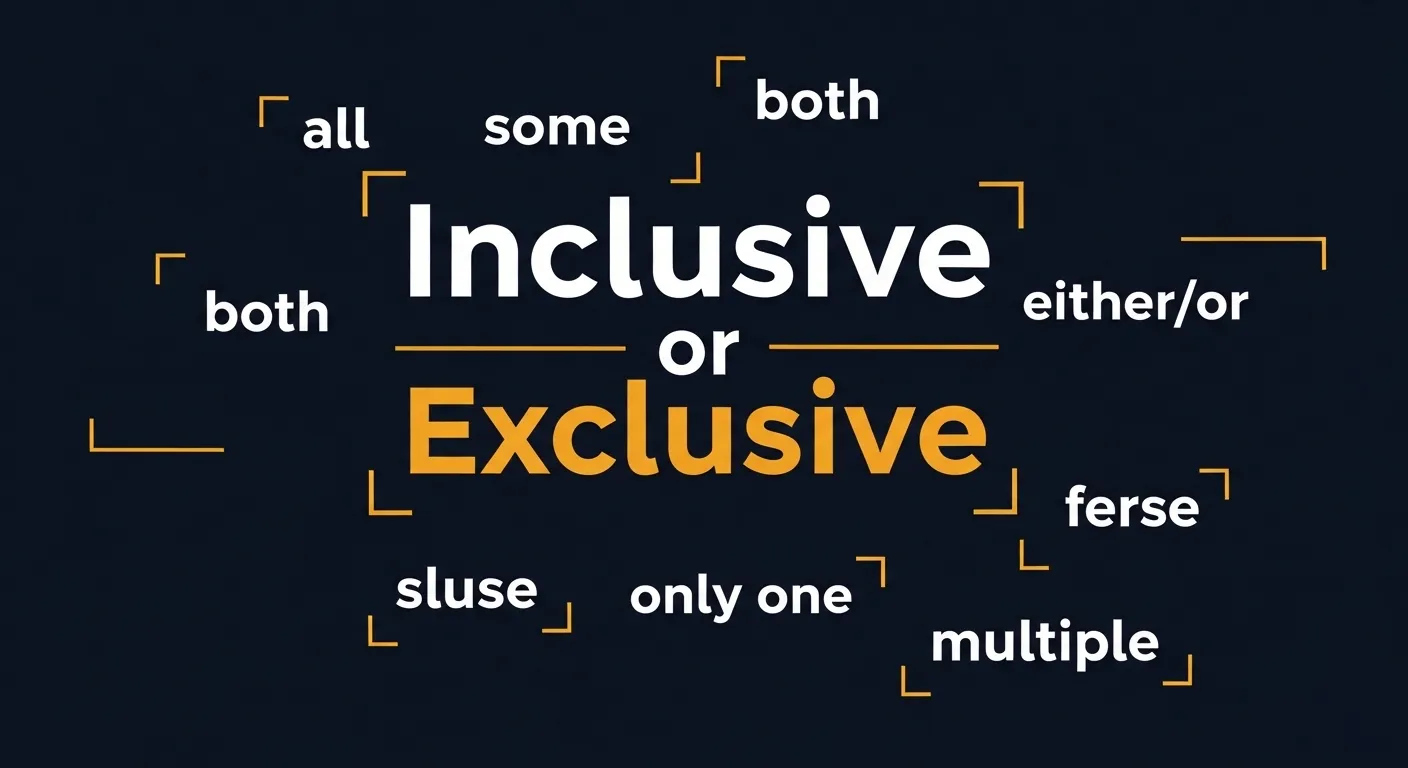
The words inclusive and exclusive are often confused, yet they have opposite meanings.
Inclusive refers to something open, welcoming, or covering all elements, while exclusive refers to something limited, selective, or restricted.
Misusing these terms can change the meaning of a sentence and create confusion, especially in formal writing, marketing, education, or professional communication.
People search for inclusive or exclusive to ensure clarity in emails, ads, essays, and social media content.
Understanding the difference helps you communicate effectively, maintain professionalism, and convey your message accurately in any context.
Inclusive or Exclusive – Quick Answer
- Inclusive → Embracing, comprehensive, or containing multiple elements.
Example: Our program is inclusive of all age groups. - Exclusive → Limited, selective, or restricted to certain individuals or groups.
Example: This offer is exclusive to VIP members.
Memory trick:
- Inclusive = in → everyone or everything included
- Exclusive = ex → out → limited or restricted
Key takeaway: The choice depends on whether you want to convey inclusion or limitation.
The Origin of Inclusive and Exclusive
- Inclusive comes from the Latin word inclusivus, meaning to enclose or contain. It has been used in English since the 16th century to denote something that embraces or contains all parts.
- Exclusive comes from the Latin word exclusivus, meaning shut out or restricted. English usage dates back to the late 16th century, often referring to limitation or selection.
Historically, these words were adopted to clarify social, legal, and religious contexts, where inclusion and exclusion had critical implications. Over time, their usage expanded into education, marketing, events, and modern discourse.
British English vs American English Spelling
| Word | British English | American English | Example |
| Inclusive | inclusive | inclusive | The school is inclusive of students from all backgrounds. |
| Exclusive | exclusive | exclusive | The exclusive offer is valid only for premium members. |
Note: The spelling of both words is identical in British and American English. The difference lies primarily in usage style rather than orthography.
Which Spelling Should You Use?
Since the spelling is consistent across regions, the focus should be on audience and context:
- Use inclusive when:
- Referring to programs, events, or policies that embrace everyone.
- Writing marketing materials for general audiences.
- Emphasizing diversity, accessibility, or openness.
- Use exclusive when:
- Referring to VIP memberships, special offers, or limited access.
- Highlighting selectivity or restriction.
- Marketing luxury or elite products/services.
Audience tip: Always match the term with the tone of your writing. Inclusive language conveys openness and approachability, while exclusive language emphasizes prestige and selectivity.
Common Mistakes with Inclusive or Exclusive
| Mistake | Correction | Explanation |
| This exclusive event is for everyone. | This inclusive event is for everyone. | Exclusive implies limitation; inclusive fits everyone. |
| The inclusive club is only for members. | The exclusive club is only for members. | Inclusive suggests openness; exclusive suggests selectivity. |
| We provide exclusive support to all clients. | We provide inclusive support to all clients. | Exclusive implies restriction; inclusive indicates all are served. |
| Inclusive VIP offer available. | Exclusive VIP offer available. | VIP implies selectivity; exclusive is correct. |
| Inclusive discounts for select members. | Exclusive discounts for select members. | Mixed meaning; use exclusive for limited access. |
Tip: Always clarify the audience or scope when choosing between these words.
Exclusive or Inclusive in Everyday Examples
Emails:
- Inclusive: Our webinar is inclusive of all experience levels.
- Exclusive: This is an exclusive invitation to our premium members.
News headlines:
- Inclusive: City launches inclusive program for all residents.
- Exclusive: Exclusive interview with the Prime Minister.
Social media:
- Inclusive: We’re proud to host an inclusive community event this weekend!
- Exclusive: Exclusive behind-the-scenes content for our subscribers only!
Formal writing:
- Inclusive: The policy is inclusive of all employee categories.
- Exclusive: Access to this report is exclusive to board members.
Exclusive or Inclusive – Google Trends & Usage Data
- Inclusive has high search volume in education, HR policies, and social discourse.
- Exclusive trends in luxury marketing, VIP offers, and media headlines.
- Countries with high inclusive usage: UK, US, Canada, Australia.
- Countries with high exclusive usage: US, UK, and global luxury markets.
Observation: Confusion mainly arises when the audience or scope is unclear. Contextual clarity ensures proper word choice.
Inclusive vs Exclusive – Comparison Table
| Word | Meaning | Example | Context |
| Inclusive | Embracing, comprehensive | Inclusive policies benefit all employees. | Education, HR, social programs |
| Exclusive | Limited, selective | Exclusive access for premium members. | Luxury, marketing, VIP events |
| Inclusive | Open to all | Inclusive community events welcome everyone. | Public events, workshops |
| Exclusive | Restricted | Exclusive deals for newsletter subscribers. | VIP offers, elite memberships |
Common Phrases and Expressions
Inclusive:
- Inclusive of all genders and backgrounds.
- An inclusive learning environment.
- Inclusive pricing for families.
Exclusive:
- Exclusive rights to publish the article.
- Exclusive membership privileges.
- Exclusive preview of the product launch.
FAQs
1. Are inclusive and exclusive opposites?
Yes. Inclusive refers to inclusion; exclusive refers to limitation or selectivity.
2. Can I use inclusive for VIP events?
No, VIP events are selective; exclusive is the correct term.
3. Is exclusive always negative?
Not necessarily; it emphasizes selectivity or prestige, not hostility.
4. Can inclusive be used in marketing?
Yes, especially to emphasize diversity, accessibility, and broad appeal.
5. Are these words spelled differently in UK vs US English?
No. The spelling is the same in both regions.
6. How can I remember the difference?
- Inclusive = in → everyone included
- Exclusive = ex → out → limited access
7. Are there idiomatic uses?
Yes, e.g., exclusive rights, inclusive of taxes, exclusive club, inclusive approach.
Tips for ESL Learners
- Look for context: Does it include everyone or limit to a few?
- Use memory tricks: in → inclusive, ex → exclusive.
- Match tone: inclusive for openness, exclusive for prestige.
- Observe usage in news, marketing, and formal writing.
Conclusion
Choosing between inclusive and exclusive is key for clear communication.
Inclusive means open and welcoming, while exclusive means limited or selective.
Misusing them can confuse readers or change meaning, especially in marketing, education, or professional writing.
Tip: inclusive = in → everyone included, exclusive = ex → limited/restricted.
Use inclusive for general audiences and exclusive for VIP or selective access. Both spellings are the same in British and American English context matters.
Correct usage improves clarity, professionalism, and engagement in emails, social media, and formal documents

I’m Debbie Young, a writer passionate about clear communication and correct English. I create practical articles on grammar, spelling, and word usage to help readers avoid common mistakes and write with confidence.