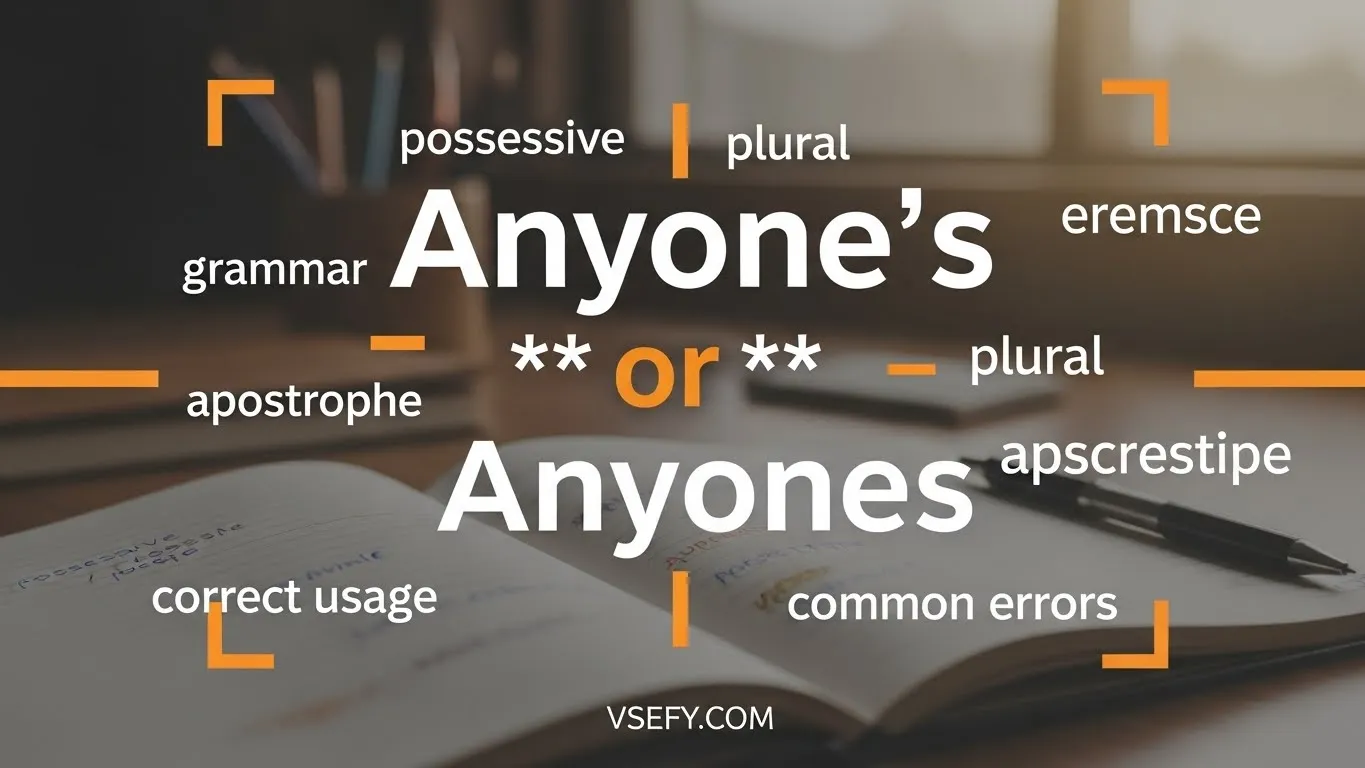
Many English learners, writers, and professionals often get confused between anyone’s and anyones.
If you’re wondering whether anyones or anyone’s is correct, the answer is simple: anyone’s is correct, while anyones (without an apostrophe) is incorrect in standard English.
Which one is correct? When should you use the apostrophe, and when is it unnecessary?
This confusion arises because English possessives can be tricky, and missing or misplacing an apostrophe can completely change the meaning of a sentence.
People search for anyone’s or anyones because they want clarity in writing whether for emails, essays, social media posts, or formal documents.
Choosing the correct form ensures professionalism, avoids grammatical mistakes, and improves readability.
This article will provide a detailed guide on the difference between anyone’s and anyones, their origin, common errors, examples in real-life writing, and tips for using them correctly in both British and American English.
Anyone’s or Anyones – Quick Answer
- Anyone’s is the correct possessive form of the pronoun anyone, meaning something belonging to any person.
- Anyones without an apostrophe is incorrect in standard English.
Examples:
- Correct: Is this anyone’s bag?
- Incorrect: Is this anyones bag?
Key Tip: Always use an apostrophe before the s to indicate possession with anyone.
The Origin of Anyone’s or Anyones
The word anyone comes from Old English ænig (meaning any) + ān (meaning one), forming a pronoun used for an unspecified person. The possessive form anyone’s follows standard English rules for forming possessives: add an apostrophe + s (‘s) to a singular noun or pronoun.
The confusion with anyones arises because English has exceptions and irregular plural forms, but anyone is singular, so the possessive apostrophe is necessary. Over centuries, the apostrophe became the standard marker of possession in English grammar.
British English vs American English Spelling
In both British and American English, anyone’s is the correct form. The difference arises only in related terms and punctuation rules.
| Type | British English | American English |
| Possessive pronoun | anyone’s book | anyone’s book |
| Plural possessive (not applicable) | n/a | n/a |
| Punctuation with quotes | Is this anyone’s? | Is this anyone’s? |
| Formal writing | Preferred in emails, reports | Preferred in emails, reports |
| Informal usage | Sometimes miswritten as anyones | Sometimes miswritten as anyones |
Key Tip: The apostrophe is essential in both variants. There is no correct spelling without it.
Which Spelling Should You Use?
- US Audience: Use anyone’s in all contexts.
- UK/Commonwealth Audience: Use anyone’s consistently.
- Global Audience: Always use anyone’s. Avoid writing anyones, which is always considered incorrect in formal and informal English.
Consistency in possessive forms ensures clear communication and professional writing.
Common Mistakes with Anyone’s or Anyones
- Omitting the apostrophe
❌ I think this is anyones responsibility.
✅ I think this is anyone’s responsibility. - Misplacing the apostrophe
❌ I think this is anyones’ responsibility.
✅ I think this is anyone’s responsibility. - Confusing plural forms
❌ Anyones are welcome to join. → Incorrect, because anyone is singular. - Overusing in informal texts without clarity
❌ Is this anyones? → Correct: Is this anyone’s? - Using anyones in formal writing
❌ Please check if this is anyones. → Always: Please check if this is anyone’s.
Anyone’s or Anyones in Everyday Examples
Emails
- Please confirm if this is anyone’s file before sending it.
News Headlines
- Is this anyone’s responsibility? Authorities respond.
Social Media
- Is this anyone’s dog? #lostdog
Formal Writing
- It is anyone’s duty to report errors immediately.
Academic Writing
- The data does not belong to anyone’s personal collection.
Anyone’s or Anyones – Google Trends & Usage Data
According to Google Trends:
- Searches for anyone’s or anyones are popular among students, ESL learners, and writers.
- High-interest regions include the US, UK, Canada, Australia, and India.
- People often search before writing emails, essays, or formal documents to ensure they use the correct possessive form.
Usage data confirms that anyone’s overwhelmingly appears in authoritative sources, while anyones is rarely correct.
Comparison Table: Anyone’s vs Anyones
| Variation | Correctness | Meaning | Example |
| Anyone’s | ✅ Correct | Possessive of anyone | Is this anyone’s notebook? |
| Anyones | ❌ Incorrect | Nonstandard | Is this anyones notebook? |
| Anyone’s (with curly apostrophe) | ✅ Correct | Possessive, stylistic | Check if this is anyone’s responsibility |
Key Takeaway: Always use anyone’s with an apostrophe for standard English.
FAQs
1. What is the correct form: anyone’s or anyones?
- The correct form is anyone’s, with an apostrophe to show possession.
2. Can anyones ever be correct?
- No, it is always considered incorrect in standard English.
3. Is anyone’s used in both British and American English?
- Yes, it is correct in both variants.
4. How do you use anyone’s in a sentence?
- Example: Is this anyone’s bag?
5. Why do people confuse anyone’s and anyones?
- Misunderstanding apostrophe rules and plural forms often causes this mistake.
6. Can anyone’s be used for multiple people?
- Yes, it refers to any individual in a group, but the possessive is always singular.
7. Are there other similar confusing words?
- Yes, such as someone’s or someones, everyone’s or everyones.
Conclusion
Understanding the difference between anyone’s and anyones is essential for clear, professional English.
Anyone’s with an apostrophe indicates possession and is correct in both British and American English. Anyones without an apostrophe is always wrong.
Correct use ensures clarity in emails, essays, social media posts, formal documents, and academic writing.
Remember, the apostrophe is not optional it marks possession and prevents misunderstanding.
By mastering anyone’s, writers and learners cancommunicate effectively, avoid common errors, and maintain credibility across audien.

I’m Ethan Hawkesley, a writer passionate about clear and correct English. I create practical articles on grammar, spelling, and word usage to help readers avoid common mistakes and write with confidence.